Berlin · Pre-seed · 2026
Give your hardware team more chances to find what works.
coscope works under an engineer’s direction to design, bringup and validate hardware, so the team can test more boards and get more chances to find what works.
Download deck
Software only, annual seat, per engineer.
8 users installed on real projects.
Raising €500k pre-seed on a SAFE, closing end of October 2026.
Tom Elliot · tom@coscope.ai
01 - The problem
Engineering time limits how many boards the team can test.
"We have to increase our shots on goal for prototypes we make." — CTO, neurotech startup
- •One engineer owns each board. The fab can build boards in parallel, but the engineer cannot work on them in parallel. When that engineer is busy or away, the board waits.
- •Fewer tries means fewer chances. Each mistake costs weeks of fab and shipping. The team must find what works before the next fundraise or phase gate.
- •The work is much more than drawing the PCB. The engineer selects components, builds libraries, brings the board up and diagnoses what fails. Getting a board that seems to work is "five percent of the way."
- •Companies fail by not getting the hardware to work. coscope gives them more shots on goal. More boards validated per engineer month.
02 - The customer & market
Hardware teams using KiCad, building multiple PCBAs per month, with the same engineer responsible for design and bring-up.
- •Recurring new designs and revisions. The number of distinct boards the team develops and tests is important, not the number of units it manufactures.
- •An experienced engineer owns the work.
- •Teams spend $1.8B a year on EDA software. Engineering labour is 5-10x on top of that.
03 - The solution
More tested boards under the engineer’s direction.
coscope does design, bring-up and validation work under an engineer’s direction, so the team has more chances to find what works.
- •Design, shipping today. Component selection and datasheet fetching, schematic-versus-board checks, ERC/DRC, floor planning against an enclosure, routing through Freerouting and documentation. The engineer reviews the output in KiCad and makes corrections where needed.
- •A record for context. Capture design decisions and their reasons in the repo today. Extend that record to measurements and fixes as bring-up and testing ship.
- •Bring-up and testing, next. Connect the design and test requirements to bench instruments, measurements and debugging, with the engineer directing and checking the work.
Product vision: Increase tested-board throughput, so smaller teams can iterate more before committing.
04 - Why now
Agents can do real EE work in the tools engineers use, and the world is in a rush to build faster.
- •Models became capable of real EE work in late 2025 and early 2026.
- •KiCad matured and is gaining broad adoption. Its open file format is compatible with coding agents, so adoption is about to explode.
- •Replace-the-EDA and prompt-to-PCB attempts failed or are failing.
- •EEs already use general AI tools, but ad hoc. They do not have a harness good enough for hardware work.
- •Geopolitical upheaval is increasing the pressure. Hardware companies are racing against China. The EU is fighting for sovereignty, both the US and the EU are rethinking their defence strategies.
The thesis: Hardware startups are under incredible pressure to build more hardware in the same time.
05 - Traction
In users’ hands, on real boards.
- •8 users have it installed on real projects with feedback arriving each week.
- •Even split across robotics, product development consulting, industrial and consumer electronics companies.
- •A new design in a weekend. A pilot reported correct parts, a floor plan and a routed board.
- •A floor plan from new constraints. A live session with a founder produced the PCBA floor plan needed for a new enclosure.
- •Debugging. coscope designed a board needed for testing robot components and sped up debugging once the board was built.
06 - Business model
$1,200 per engineer, per month.
Annual seat, sold to the engineering lead. Design partners get their first months free, then 50% pricing ($600/mo) locked for their first year. Pilot users have accepted these terms verbally.
- •$14,400 per seat per year. A two-seat team is a $28,800 annual account.
- •Recurring board development is the buying context. The target customer has new designs and revisions to prepare and test throughout the year.
- •The value to prove is more completed hardware experiments. Measure boards tested and questions answered alongside the engineer’s review, correction and bench time. Paid conversion must establish that this is worth the annual commitment.
07 - Alternatives
The engineer still needs a complete experiment.
| Approach | What the team gets | What remains |
|---|---|---|
| KiCad and the existing manual workflow. | Direct control over design and review. | Engineering time for research, preparation, documentation and bench work. |
| General-purpose models with a custom tool setup. | A workflow the team can adapt itself. | The team builds and maintains the connections to its files, tools and instruments. |
| Separate tools for design, firmware and test. | Specialized support for individual tasks. | The team connects the design decisions, test requirements and results. |
| coscope. | Connected design tasks and a project record on the team’s KiCad files today. | Bring-up and testing are roadmap work. The engineer retains judgment and verification. |
08 - Why me
20 years taking hardware from lab bench to factory line.
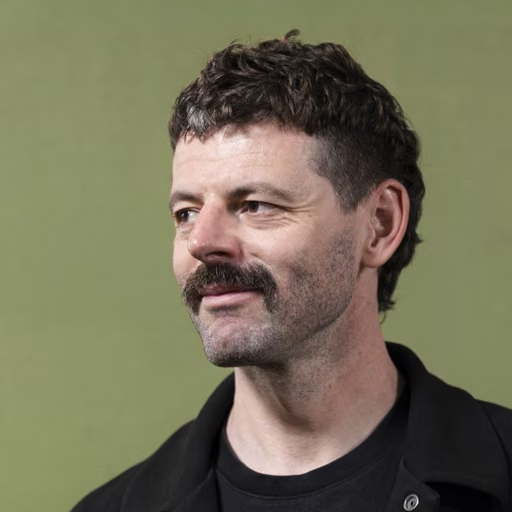 Tom Elliot - Founder
- •Domain expert. I've worked on electronics development from consumer electronics to industrial equipment. From individual contributor to managing teams. From research experiments to units manufactured in the millions.
- •Product experience. I've bootstrapped several B2B SaaS products over the last few years (some even made money).
- •AI pilled. I have been using LLMs in SaaS products since 2023. I have Openclaws, Hermes' and custom built agents doing work for me both professionally and personally. I am on top of the latest trends (I've got Jev built into some tooling for coscope already).
- •Vision. I don't think "prompt-to-PCB" is enough. The real impact is having a coordination layer across the whole EE workflow, allowing the EE to work at a higher level of abstraction across more parallel workstreams.
09 - The ask
€500k pre-seed, SAFE, closing end of October 2026.
Allocation:
- •Hiring My attention stays on customers, product and the business model.
- •Founder's associate
- •Resident engineer
- •Distribution. Founder-led sales converts the live pilots into paying design partners, backed by reference builds documenting the design, bring-up, test results and resulting decisions.
- •Compute. Model and tool execution for design tasks and the planned bench workflow.
Goal: 3+ paying design partners at 5-figure ARR.
Potential non-dilutive funding through German R&D grants.
Give your hardware team more chances to find what works.